
Neurodiversity
Advanced Anomaly Detection Is Here Are You Ready To Capitalise?
The most powerful QA capability in your business might be the one you haven't hired yet.
You've probably heard that companies like Microsoft actively recruit neurodivergent people. The 'why' is a deep, complex, well-researched subject. I'm going to walk straight past all of that. Instead, I want to share a little game I've run with clients over the years, one I was once a participant in myself.
A quick note before the game: not everyone with a neurodivergent brain can do this, and not everyone who can do it is neurodivergent. It's meant to be fun, usually with a small prize for the fastest finder. I didn't invent it, I just love it because it makes something abstract feel tangible.
The game
The rules are simple: the fastest person to find something wrong wins.
No instructions, no explanation of what they're about to see. Just a five-minute cap on the clock.
I tell the participant there's something wrong with what I'm about to show them, start the timer, and turn over a page printed with 1,000 small, randomly placed numbers made up from the digits 1, 2, 3, 4, 5, 6, 7, 9 and 0.
The single anomaly is the number 8.
It's a bit like Where's Wally, except you don't know you're looking for Wally, or even that there's a Wally to look for.
The result
The last time I ran this was at a client with a genuinely diverse group of volunteers.
Out of the people who considered themselves neurotypical, one person found the 8. Most hit the five-minute cap without spotting it. That's typical.
Out of the neurodivergent group, not everyone found it, but most did, and the average time was just under a second. Essentially: as soon as I turned the paper around.
Are they superhuman? What's actually happening?
I can't speak for every autistic person, or every neurodivergent person, but I can tell you how it works for me.
When I first did this, I also found the anomaly in under a second. I'm not superhuman. If you asked me to read every number on the page to find the anomaly, I'd be no faster than anyone else.
But the game doesn't ask you to read all the numbers. It just says something is wrong.
So how did I find it so fast?
It was the only thing I could see.
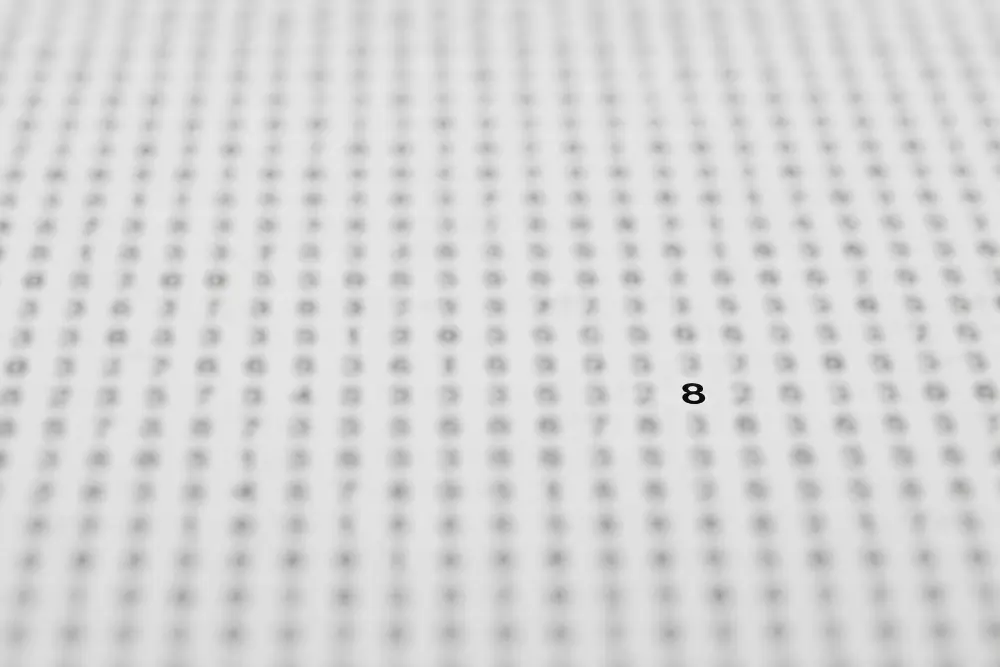
There's plenty of research on why and how this works. I like to think of it as a natural part of what makes our world work.
Let's take a functioning company as an example: if everyone worked at an abstract level, the vision would be brilliant and the execution dreadful. If everyone worked in hyper-detail, you'd ship nothing and sell nothing to a board. Cognitive diversity isn't a nice-to-have, it's how things actually get built.
Is this only something super-smart autistic people can do?
Absolutely not. I've run the same game with groups of people with learning difficulties and the pattern is identical, some find it in under a second, some don't. It's a natural phenomenon, not a credential.
Why am I writing this?
Firstly, because I think it is something people might find interesting.
Secondly, and more practically: AI is generating code faster than humans can review it. Output is going up. Subtle, plausible-looking bugs are going up with it. The bottleneck isn't writing code anymore, it's catching what's wrong, anomalies, regressions, subtle inconsistencies.
If you're going to need more QA capacity, and you almost certainly are, then it's worth knowing that advanced anomaly detection capabilities are built directly into the brains of a huge and largely untapped pool of talent.
Let's benchmark this. HI (human intelligence) vs AI (artificial intelligence).
For advanced anomaly detection, who wins?
Finding anomalies in screenshots, code reviews, data tables, live conversation: both can do it. HI tends to edge the visual end, screenshots, mock ups, anything with layout. And there's one thing HI does that AI still can't, when it spots something, it's actually there. No hallucinated bugs, no confidently wrong answers.
Having a cup of tea with one of your team, contributing to the morale and diversity of your business, generating ideas that aren't already in a generalised corpus of approaches: HI wins. For now.
Why I'm focusing on QA specifically
I should be honest about why I'm pointing at QA. I'm an architect, not a recruiter, but for years I've been quietly helping people from special education schools and charities find roles, alongside the day job. Sometimes that's with my own clients, sometimes it's with companies I've introduced them to and then helped guide through the process. Some of those connections I've made myself, others have come via charities. Most have gone into QA, a few into developer roles, though developers have always been a much harder sell. That's a commentary on hiring culture, not on capability. QA tends to be where companies are more willing to take the first step. I am in no way saying QA is the natural place for a neurodivergent person. I am an architect.
If you want to explore this and aren't sure where to start, get in touch. There are some excellent organisations that specialise in this, and I'd be happy to introduce you to the ones I've worked with such as The Kaleidoscope Group, who help disabled people find purpose and meaningful work.
Don't overthink it. In fact, hire from this pool and you'll have people who can do the overthinking for you. What more could you want in a QA tester?