
Governance
I Caught Mad Architect Disease... You Might Have It.
In order to protect the identity of the people and tech involved, I've changed the client's name and the technologies in use. Any resemblance to real cloud wikis, diagramming tools or design platforms is entirely coincidental. Obviously.
Ok, let's start at the beginning.
A long, long time ago, in a faraway land known as Client Site, there lived a young and overly opinionated architect. He had taken it upon himself to deliver the good people of Client Site from the dreadful realm of cursed legacy contraptions such as SightKor, and other dark sorceries that had, for many a year, been systematically draining the life from the code-wrights, the long-suffering peasantry, and the Lord High Keeper of the Coin Purse.
Our hero knew exactly how to rescue them from this darkness. He need only set the plan to parchment.
The townsfolk had, most fortuitously, already unearthed an instrument for the scribing of such prose and shapes. It was known as Loocide Charts.
Our hero was much taken with Loocide. It became his most beloved instrument in all the land.
What wonders could one commit to Loocide? Why, near enough anything the architect might require. And lo, it did not end there. For the comfort and ease of the townsfolk, the works within Loocide could be shared freely with Konflooence, and with sundry other cloud-based services besides.
The ease with which the architectural plan could be shared was a wonder to behold. And so it came to pass that Client Site were delivered from the evil clutches of the crumbling, cursed scriptorium of SightKor, and there was much rejoicing throughout the land.
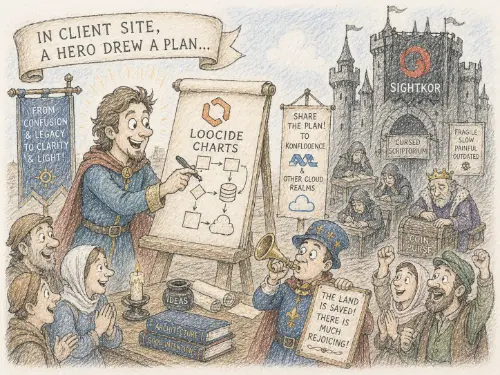
Since those ye-olden days, the sharing has only grown more bountiful. New and magical players have arrived upon the scene: Meero, Nosshion, Figgmar. Now we might commit to parchment the business flows also, and the user journeys, and the roadmap of what was yet to come.
What a truly magical time we live in.
Unless...
OK, I'm going to translate it to modern language, just to check that what I did was actually good.
So… I put the full component list into Loocide. And the domain map of which service owns what. And the integration map of how it all connects.
And the DevOps team, being helpful, added the network topology. Every subnet, VPN and firewall rule. Beautifully colour-coded.
And the database team, not to be outdone, uploaded the schematics. Including dialect and version. With an ERD that names every table and every field, helpfully flagging the PII ones in red so they're easy to spot.
And the security team wrote up the encryption posture, in the same wiki, on the page right next door. Which, as a side effect, also documents where it isn't applied.
And the UX team put the full user journeys into Figgmar. Including the admin flows. Including the screens you only see if you have elevated privileges.
And the product team put the roadmap into Konflooence. "OAuth migration, planned Q3." "Rate limiting on the reporting API, planned Q4." A publicly readable calendar of which systems are currently vulnerable, and for how much longer.
And the project team, bless them, linked it all together in one lovely landing page called "Architecture", so that anyone joining the company could get up to speed quickly.
Ah.
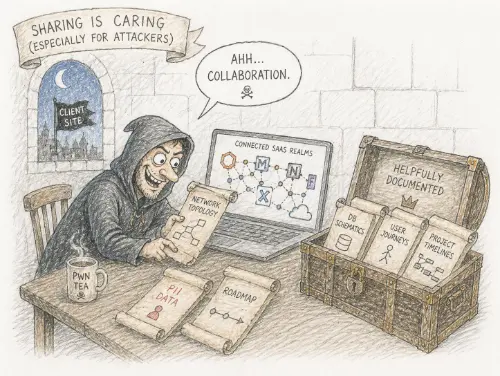
If an attacker had walked into the office, opened a laptop, and written all this down from scratch, we would have called it reconnaissance and called the police. We wrote it ourselves, across six teams and several tools, and called it collaboration.
That's mad-architect disease.
And the frightening thing is you don't catch it by being careless. You catch it by being diligent. By documenting thoroughly. By sharing widely so the team can collaborate. By using the industry-standard tools the way the industry uses them.
Do you have it?