
AI
Just A Little Hallucination. Did I Say That?
Hallucination has become the ubiquitous term for incorrect when it comes to AI, which it turns out we humans are for the most part comfortable with. The made-up case law, the invented quote, the confident wrong answer.
As a user of various LLMs, I know it's easy to let speed of answer and speed of coding sit higher than correctness, so what's the harm? That depends, and it depends a lot on context.
What I want to talk about are the little hallucinations. The ones nobody notices. The ones that are subtle. The ones spreading quietly through everything we write.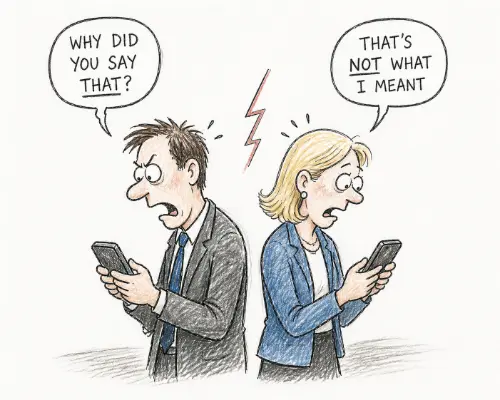
The best way to show this is with a very common example, I popped this into one of the leading models at time of writing.
I wrote:
The person really knew their stuff, I was impressed with their ability to beat everyone in the debate, fantastic effort for someone so young
Can you please fix the grammar
The output:
That person really knew their stuff. I was impressed by their ability to outperform everyone in the debate—an outstanding effort for someone so young.
Has it improved the grammar? Absolutely. But is it the same message?
Look at three changes in particular.
"beat everyone" became "outperform everyone". Beat implies a contest, a winner, someone coming out on top. Outperform is the language of measurement and metrics. Different worlds.
"fantastic effort" became "an outstanding effort". Fantastic carries warmth, it sounds like a real person who was impressed. Outstanding is the language of a performance review.
"impressed with" became "impressed by". More standard, sure, but impressed with is how people actually speak.
The grammar is cleaner, but the speaker has changed. The first version sounds like a person. The second sounds like HR.
Same subtlety, less benign
That first example isn't going to cause any damage, it just isn't quite what I said. But the shift is real, and once you start noticing it you can't unsee it. So let's go a little deeper. Let's look at a change that's just as subtle, but where the consequences are harder to brush off.
I wrote:
He reluctantly agreed with the terms
Can you please fix the grammar
The output:
He reluctantly accepted the terms.
Accepted and agreed are not the same thing!. The meaning of the original sentence has been erased.
You can agree with terms but not accept them, you're the person who thinks something is fair and walks away anyway. You can accept terms but not agree with them, you're the person who goes along with something because you have to, not because you think it's right. One is about what you believe, the other is about what you're bound to.
And the model collapsed that distinction to tidy a preposition.
And all we asked for was a grammar fix!
Now scale this up. Consider the millions of emails every day being cleaned and subtly drained of warmth. The global corpus of legal documents being exchanged, where an agreement quietly becomes an acceptance. The diagnoses being rewritten in ways that evoke more fear, or less, than the writer intended. The political discourse being dampened or heightened, where very aggressive becomes a little aggressive, or the other way around.
Every one of these edits is tiny. Most won't notice. Many will choose speed over correction. Everybody moves on.
Are we heading towards the mean average of human discourse?
Is this the beginning of the erosion of creative thought and individuality?
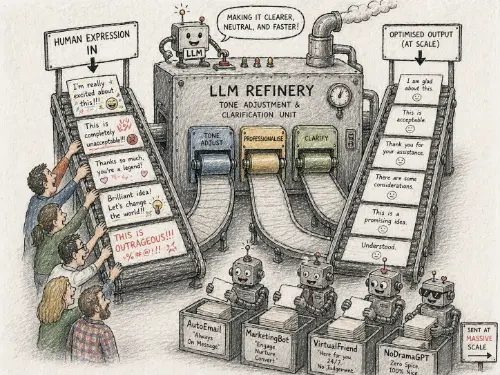
Or is there a more concerning lens we should be adopting? Is it really the mean, or is it an artificial mean, created by the model providers and their huge rafts of synthetic data, slowly moulding how we communicate with each other?
At a macro level that is concerning. At a micro level it should be understood and factored into your comms strategy. Join the mean, or stand proud with your non-em-dashed prose.
Has anyone worked out where the em dash is on the keyboard yet?